Thursday, 24 April 2014

The Amazingness of Year 0

15 5yr olds + 2 teachers + 1:1 iPads + 1 App = Amazing learning (for all)

As a part of my MIT Inquiry for this year, I spent a day hanging with the amazingness that are Michelle George and Karen Belt.

Their 5yr olds had spent only 6 weeks at school by the time I got to visit them. 6 weeks to learn routines, habits and skills to set them up for a life time of learning.

Karen and Michelle have these kids so engaged with learning how to be a learner - and at the same time teaching those valuable skills of reading, writing and arithmetic.

These first two movies are examples of "writing time". In this Year 0 class the students co-construct their writing through song. The rhythm and beat make the language and structure much simpler to recall.


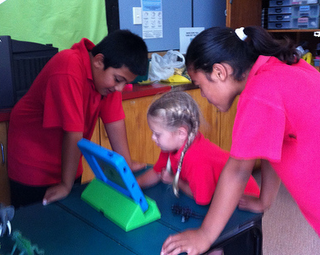
Students then record each other "singing" their story back again, These recordings are shared via the class Apple TV - The 5yr olds have no problem waiting for their turn and then Air Playing their device independently.  The kids even figured out early on, that they needed to film each other using the other person's iPad - keeping that record of rewindable learning on each student's own device.


Reading is still conducted in a guided sense with the teacher and small groups of 3.
The iPad comes in as the teachers utilise Explain Everything for the students to complete "Follow-Up" activities, These may involve arranging sentences, drawing a picture or practicing words. The power is that each student records their learning while they undertake the activity.
No longer is the teacher left out of the independent learning. A quick rewind and you are there with the student as they complete the task. You can truly hear them think.


Major things are happening for our smallest students and as their teachers we need to ensure that this learning develops as they move through the school.
I can see great connections with my learners and the way thinking, self management and contributing are central to their day to day tasks.
Such an honour to share a day with these ladies and children as they explore such engaging ways to encourage great learning in their classroom.


Hapara Teacher Dashboard - Limitless Boundaries


After 3 years in an almost entirely Google Environment, I was heavily reliant upon Hapara's Teacher Dashboard for work flow and monitoring.
Every student knew that their work was visible to all the right people (and beyond) with only one click. As the teacher, I knew that I could always keep on top of what was going on with such young learners.


As I made the switch to a 1:1 iPad class, I did wonder how Teacher Dashboard would hold up with non-Google products.


Again, I find myself being unable to live without this tool.

We are essentially a 1 App outfit,  in that the students are learning solely with Explain Everything. Of course they share via their blog utilising Flickr and Vimeo - but fundamentally the children would agree that we use 1 App.

The students very quickly became proficient with creating their own EEs and I was moving into creating templates that I wanted them to use. The Smart Copy function on TD allows me to Smart Copy the EE Template directly to the folder of each student - it even names the EE correctly as it copies.

What could be simpler than students opening the App and finding their work waiting and ready to go? For 7yr olds, this technology has made our learning smoother, simpler and emphasises the learning - not the tech.

To think that TD functions this beautifully across platforms excites me. Almost limitless boundaries as we explore learning, creating and sharing on tablet devices in our junior school.

Tuesday, 18 March 2014

Listening to Them Think

I just LOVE listening to the kids think as they complete activities using Explain Everything. The perfect way to really assess understanding.


Saturday, 15 March 2014

New Things to Think About

Even though I have spent 3 years in 1:1 Chromebook classes and 5 years running GAFE,  there is still so much to learn in terms of delivering a truly digital, engaging, collaborative program, where learning is at the centre.

With the switch to iPads from Chromebooks, I knew that some technical pieces wouldn't quite fit the puzzle in the same way and that I would need to adapt around that  - no problem. I figured smaller kids would take longer to work things out - again,  no problem. What I didn't count on, was that I would be changing up the pedagogy so early on.

2 years ago I made the conscious decision to develop a more cognitively engaging maths program where the students were prompted to discuss and orally share rather than fill out worksheets to practise strategies. Why I never carried this over to my literacy program, I am not so sure.

With young students using iPads, there is a limit to how successful they are at directing a cursor to an exact point on a Google Doc, the highlighting of specific text and shuffling around is quite cumbersome and the interaction between our class sites and Apps is not so smooth.

My initial reaction was that these skills would come with time and in the interim I began to print out group reading response sheets. This was a successful change, in the fact that the students were very familiar with paper and pencil and the "kids could get on with their work."

The more I thought about how to fix this problem, I started to feel that the problem was in what I was asking the students to do, not in how they were doing it.

Was I providing an engaging, collaborative reading program that was focused on Key Competencies and the development of reflective learners? - Nope.

Why wasn't the literacy program more discoursive and reflective?

As a class we are working towards sharing ideas, relating to others and participating, these can only be developed through interactive, shared experiences - Certainly not by completing a "follow up response sheet".

So to start the new week on Monday, Class 12 has a new approach to literacy. We're still going to read HEAPS of books. We're going to learn new words and phrases. We're going to make sure that we are understanding the message in our stories.
We're going to do all this by talking about our books and sharing our new learning in a discoursive and detailed fashion.

Explain Everything is proving to be an even more powerful app than first thought and coupled with Hapara's Teacher Dashboard, the sharing of templates and completed movies, is just far too simple.

So watch the kids' blogs, as we aim to share even more awesomeness.


Tuesday, 4 March 2014

Owning Their Learning

As we are now solidly into routines and life at school, I was interested in finding out what, in actual fact, the students had internalised around the Key Competencies.

 How were they perceiving their learning, their success and their struggle?
 What do they Key Competencies mean to 7yr olds and their learning?

 I must admit that I have been pleasantly surprised by the first group to share their thoughts. The learners are clearly able to articulate their understandings and create both reflective and prospective moments in their own learning.

 How cool is it to see small children talking like this about learning?


Tuesday, 25 February 2014

A "Fun" Beginning

So it has been a dynamic start to 2014 in Class 12.

After having taught senior students for the last 5years, I knew that scaling back on my expectations for the smaller children would be essential.
I am pleasantly surprised.

Bar one or two failed lessons, the students are picking up Learn, Create, Share very quickly.
Just check out the sheer number of individual blogposts!


There is a real love for learning and achievement in the class, but very few of the learners possess the capacity to know where to begin independently. I find myself giving instructions 5 times, repeating them 5 times and working individually with students as they struggle through tasks.

A life skill that I am trying to entrench is the idea shared at Educamps - "The answer is in the room." That the people around you have the answers to help you out.

Many students are reluctant to ask for help, yet when they do, their classmates seem reluctant to share. Many perceive sharing with others as "cheating". Also the belief is strongly held that the teacher has all the answers so I will wait until she tells me what to do.


Our challenge for the next few weeks is to develop more of a collaborative approach to learning and the desire to share the learning with others in the room. This is a new head space for my wee crew and one that will take some tackling.


The Key Competencies of Participation, Relating to Others and Thinking will take centre stage in this approach.

Tuesday, 4 February 2014

The Plan for 2014

The NZ Curriculum has within it a beautiful gem - the Key Competencies.  My plan for 2014 is to teach children explicitly through the understandings of the 5 Key Competencies. Once students fully grasp the point and understanding of the Key Competencies then true independent learning can thrive.


So my plan for 2014 is to explicitly discuss, share and talk about why, how and when we are learning with the Key Competencies. Despite the children being young, I know that being able to discuss the ins and outs of learning can only benefit the learner.
Around the classroom walls and on the classroom Google site the Key Competencies are prominently displayed.


As a class we spent 4 x 10 minute pockets of the first day of school talking through what the KCs are and helping to define them. We discussed how an activity, which on the surface appeared to contain no learning, had all 5 Key Competencies embedded within and what we had learnt because of that experience. As we chatted it seemed as if the odd light bulb was turning on and cogs were grinding.  On only the second day of school, without prompting, different students referred to the KCs independently when we began to talk about our learning for the day and what we would be thinking about.  These kids are only 7 or 8 years of age and are so receptive to hearing about the whys and whats of learning.


We will be documenting the students' thinking and learning with a 1:1 iPad program. By doing this we are creating not just a reflective act but also a prospective one as it shapes the design of future learning needs. Students are metacognitively processing their achievements and failures, leading to an increased understanding of their own learning journey.


Some students this year are highly impulsive and prone to over-sharing. These students will thrive in this environment as they are already responding to subtle cues for self management and are enjoying the discussion and sharing around their learning.

I am really looking forward to 2014 and the possibilities that this approach could bring. We will be documenting, sharing and reflecting on our learning via our student blogs.

Bring on the choice learning!